N,N’-Bis(9,9-dimethyl-9H-fluoren-2-yl)-N,N’-diphenylbenzidine CAS#: 361486-60-4; ChemWhat Code: 458013

Identification
| Product Name | N,N’-Bis(9,9-dimethyl-9H-fluoren-2-yl)-N,N’-diphenylbenzidine |
| IUPAC Name | N-[4-[4-(N-(9,9-dimethylfluoren-2-yl)anilino)phenyl]phenyl]-9,9-dimethyl-N-phenylfluoren-2-amine |
| Molecular Structure | 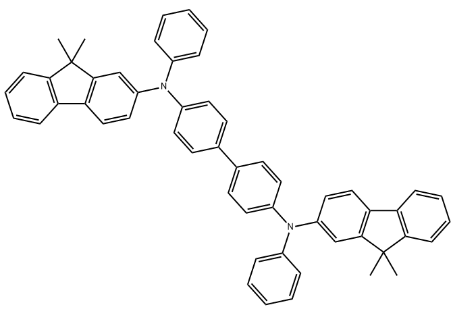 |
| CAS Registry Number | 361486-60-4 |
| MDL Number | MFCD20528032 |
| Synonyms | 361486-60-4 BF-DPB N,N’-Bis(9,9-dimethyl-9H-fluoren-2-yl)-N,N’-diphenylbenzidine N-[4-[4-(N-(9,9-dimethylfluoren-2-yl)anilino)phenyl]phenyl]-9,9-dimethyl-N-phenylfluoren-2-amine SCHEMBL81074 diphenylbiphenyl-4,4′-diamine MFCD20528032 AKOS037478182 N4,N4′-bis(9,9-dimethyl-9H-fluoren-2-yl)-N4,N4′-diphenyl-[1,1′-biphenyl]-4,4′-diamine B4962 ,N4′ – T70829 ,N4′ -Bis(9,9-dimethyl-9H-fluoren-2-yl)-N4 N-[4-[4-(N-(9,9-dimethylfluoren-2-yl)anilino)phenyl]phenyl]-9,9-dimethyl-N-phenyl-fluoren-2-amine |
| Molecular Formula | C54H44N2 |
| Molecular Weight | 720.9 |
| InChI | InChI=1S/C54H44N2/c1-53(2)49-21-13-11-19-45(49)47-33-31-43(35-51(47)53)55(39-15-7-5-8-16-39)41-27-23-37(24-28-41)38-25-29-42(30-26-38)56(40-17-9-6-10-18-40)44-32-34-48-46-20-12-14-22-50(46)54(3,4)52(48)36-44/h5-36H,1-4H3 |
| InChI Key | VZYZZKOUCVXTOJ-UHFFFAOYSA-N |
| Isomeric SMILES | C1CC1(C2=CC=CC=C2C3=C1C=C(C=C3)N(C4=CC=CC=C4)C5=CC=C(C=C5)C6=CC=C(C=C6)N(C7=CC=CC=C7)C8=CC9=C(C=C8)C1=CC=CC=C1C9(C)C)C |
| Patent Information | ||
| Patent ID | Title | Publication Date |
| WO2023/100615 | IRIDIUM COMPLEX, ORGANIC LIGHT-EMITTING DEVICE, DISPLAY DEVICE, IMAGING DEVICE, ELECTRONIC EQUIPMENT, LIGHTING DEVICE AND MOVING BODY | 2023 |
| US2023/120404 | COMPOUND, MATERIAL FOR ORGANIC ELECTROLUMINESCENT ELEMENTS, ORGANIC ELECTROLUMINESCENT ELEMENT, AND ELECTRONIC DEVICE | 2023 |
| US2023/157166 | ORGANIC COMPOUND AND ORGANIC LIGHT-EMITTING ELEMENT | 2023 |
| CN117024369 | Multiple host materials and organic electroluminescent device comprising same | 2023 |
Physical Data
| Appearance | Light green powder |
| Melting Point, °C |
| 267 |
Spectra
| Description (NMR Spectroscopy) | Nucleus (NMR Spectroscopy) | Solvents (NMR Spectroscopy) |
| Chemical shifts | 1H | chloroform-d1 |
| Description (UV/VIS Spectroscopy) |
| Spectrum |
| Spectrum |
Route of Synthesis (ROS)

| Conditions | Yield |
| With tri-tert-butyl phosphine; palladium diacetate; sodium t-butanolate In toluene at 100℃; for 3h; Inert atmosphere; Experimental Procedure 3 Synthesis of 4,4′-bis[(9,9-diphenylfluoren-2-yl)(phenyl)amino]biphenyl (Compound 1-21) Bis(phenylamino)biphenyl (10.0 g), 2-bromo-9,9-dimethylfluoren (17.1 g), toluene (100 mL), and tert-butoxy sodium (8.6 g), were added into a nitrogen-substituted reaction vessel and aerated with nitrogen gas under ultrasonic irradiation for 30 minutes. The mixture was heated after adding palladium acetate (0.1 g), a toluene solution (0.2 g) containing 50% (w/w) tert-butylphosphine, and stirred at 100° C. for 3 hours. The mixture was cooled to 80° C., hot filtration was carried out. Silica gel and activated clay were added to the filtrate to perform adsorption purification, and the solid was removed by filtration. The filtrate was concentrated and the precipitated solid was collected by filtration. The obtained solid is recrystallized with toluene, whereby a yellow powder of 4,4′-bis[(9,9-diphenylfluoren-2-yl)(phenyl)amino]biphenyl (Compound 1-21; 16.4 g; yield 77%) was obtained. The structure of the obtained yellow powder was identified by NMR. 1H-NMR (CDCl3) detected 44 hydrogen signals, as follows. δ (ppm)=7.62-7.65 (4H), 7.52-7.53 (4H), 7.10-7.45 (20H), 7.06-7.10 (4H), 1.47 (12H). | 77% |
Safety and Hazards
| GHS Hazard Statements | Not Classified |
Other Data
| Transportation | Under room temperature away from light. |
| HS Code | |
| Storage | Under room temperature away from light. |
| Shelf Life | 1 year |
| Market Price |
| Druglikeness | |
| Lipinski rules component | |
| Molecular Weight | 720.957 |
| logP | 17.104 |
| HBA | 2 |
| HBD | 0 |
| Matching Lipinski Rules | 2 |
| Veber rules component | |
| Polar Surface Area (PSA) | 6.48 |
| Rotatable Bond (RotB) | 7 |
| Matching Veber Rules | 2 |
| Use Pattern |
| N,N’-Bis(9,9-dimethyl-9H-fluoren-2-yl)-N,N’-diphenylbenzidine CAS#: 361486-60-4 is an efficient emissive material often used in organic light-emitting diodes (OLEDs). The fluorenyl and diphenylamine groups in its structure provide excellent electron transport and emission properties, enhancing the device’s luminous efficiency and brightness. The chemical structure of BF-DPB imparts excellent thermal stability. This stability is crucial for the prolonged operation of optoelectronic devices under high-temperature conditions, increasing the device’s lifespan and reliability. |
Buy Reagent | |
| No reagent supplier? | Send quick inquiry to ChemWhat |
| Want to be listed here as a reagent supplier? (Paid service) | Click here to contact ChemWhat |
Approved Manufacturers | |
| Want to be listed as an approved manufacturer (Requires approvement)? | Please download and fill out this form and send back to approved-manufacturers@chemwhat.com |
Other Suppliers | |
| Watson International Limited | Visit Watson Official Website |
Contact Us for Other Help | |
| Contact us for other information or services | Click here to contact ChemWhat |