3-ETHOXYACRYLIC ACID CAS#: 6192-01-4; ChemWhat Code: 907618

Identification
| Product Name | 3-ETHOXYACRYLIC ACID |
| IUPAC Name | (E)-3-ethoxyprop-2-enoic acid |
| Molecular Structure |  |
| CAS Registry Number | 6192-01-4 |
| MDL Number | MFCD01566841 |
| Synonyms | (E)-3-Ethoxyacrylic acid 695-656-3 3-Ethoxyacrylic acid 6192-01-4 14674-80-7 3-ethoxyprop-2-enoic acid 2-Propenoic acid, 3-ethoxy-, (2E)- 3-Ethyoxyacrylic acid (E)-3-ethoxyprop-2-enoic acid (2E)-3-ethoxyprop-2-enoic acid 3-Ethoxy-2-propenoic acid 3-Ethoxyacrylicacid MFCD01566841 (2E)-3-Ethoxyacrylic acid NSC364201 (E)-3-ethoxy-acrylic acid 3-ethoxyacrylic acid, AldrichCPR BCP05609 AKOS006228816 CS-W019195 NSC-364201 AS-11132 AS-57294 CS-0166780 EN300-125926 EN300-307457 |
| Molecular Formula | C5H8O3 |
| Molecular Weight | 116.11 |
| InChI | InChI=1S/C5H8O3/c1-2-8-4-3-5(6)7/h3-4H,2H2,1H3,(H,6,7)/b4-3+ |
| InChI Key | SYMAGJYJMLUEQE-ONEGZZNKSA-N |
| SMILES | CCO/C=C/C(=O)O |
Physical Data
| Appearance | Light yellow flaky solid |
| Melting Point, °C | Solvent (Melting Point) |
| 107 – 109 | |
| 107 – 108 | diethyl ether |
| 106 – 108 | petroleum ether |
| 109 | H2O |
| 110.5 | H2O |
| 110 |
| Boiling Point, °C | Pressure (Boiling Point), Torr |
| 87 | 5 |
| Density, g·cm-3 | Reference Temperature, °C | Measurement Temperature, °C |
| 1.11 | 4 | 20 |
| 1.24 |
Spectra
| Description (NMR Spectroscopy) | Nucleus (NMR Spectroscopy) | Solvents (NMR Spectroscopy) | Frequency (NMR Spectroscopy), MHz |
| Chemical shifts | 1H | chloroform-d1 | 400 |
| Chemical shifts | 1H | dimethylsulfoxide-d6 | |
| Chemical shifts | 13C | dimethylsulfoxide-d6 | |
| Spin-spin coupling constants | dimethylsulfoxide-d6 | ||
| Chemical shifts | 1H | CDCl3 | |
| Spin-spin coupling constants | CDCl3 |
| 3-ETHOXYACRYLIC ACID CAS#: 6192-01-4 NMR | 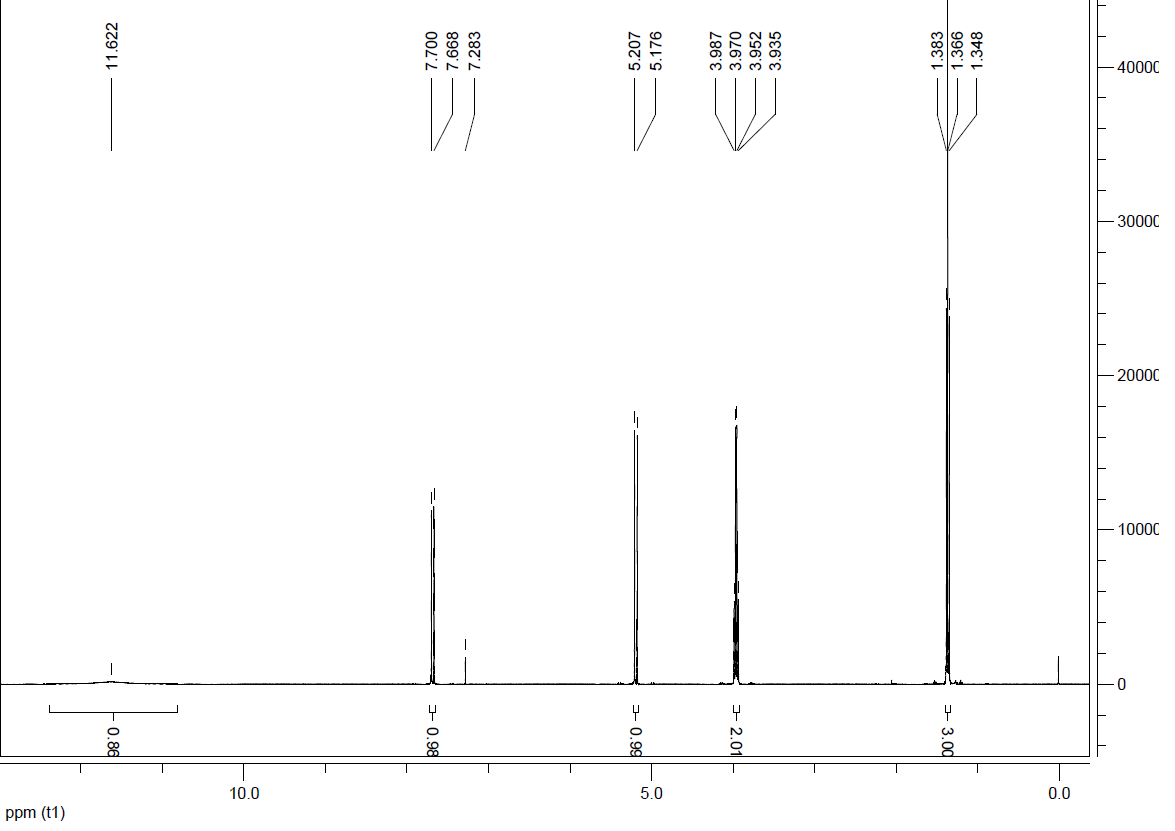 |
| Description (IR Spectroscopy) | Solvent (IR Spectroscopy) |
| Bands | KBr |
| Description (UV/VIS Spectroscopy) | Solvent (UV/VIS Spectroscopy) |
| Spectrum | ethanol |
Route of Synthesis (ROS)

| Conditions | Yield |
| With oxalyl dichloride Yield given; | |
| With oxalyl dichloride In dichloromethane at 0 – 20℃; Inert atmosphere; Experimental Procedure Example 6Preparation process of compound 25:S1.Preparation of (E)-3-ethoxy-N-(2-hydroxy-4-methylphenyl)acrylamide (LQM-01)Weigh 9.43 g of 3-ethoxyacrylic acid (81.20 mmol, 1.0 eq)In a dry 250 mL round bottom flask, protected by a nitrogen atmosphere,Add 100 mL of anhydrous DCM; then,60.90 mL of oxalyl chloride (121.80 mmol, 1.5 eq, 2.0 M in DCM) was slowly added dropwise at 0 °C.Stirring at room temperature overnight;Evaporating the solvent under reduced pressure to give an acid chloride compound;Another 10 g of 2-amino-5-methylphenol (81.20 mmol, 1.0 eq)In a dry 500mL two-necked bottle, protected by a nitrogen atmosphere,150 mL of dry DCM was added.Add 100 mL of anhydrous DCM to the acid chloride compound,Transfer the acid chloride compound to the reaction at 0 ° C,Finally, 13.07 mL of anhydrous pyridine (162.40 mmol, 2.0 eq) was added.The reaction was stirred at room temperature overnight. After TLC tracks the reaction,Pour the reaction solution into 250 mL of ice water.It was extracted with DCM (250 mL x 2) and the obtained organic phase was combined twice.5% HCl solution (250 mL × 2),The organic phase was washed with saturated NaHCO3 (250 mL×2) and saturated NaCI (250 mL×2)Filtered, and evaporated to dryness under reduced pressure.A tan solid was obtained.After dissolution with a small amount of DCM, petroleum ether was recrystallized and allowed to stand overnight.Filtered, the filter cake is washed thoroughly with petroleum ether.Obtained 10.97 g of a yellow solid;Yield: 61.0%, yellow solid. | |
| With thionyl chloride |
Safety and Hazards
| Pictogram(s) |   |
| Signal | Danger |
| GHS Hazard Statements | H314 (33.3%): Causes severe skin burns and eye damage [Danger Skin corrosion/irritation] H318 (33.3%): Causes serious eye damage [Danger Serious eye damage/eye irritation] H319 (33.3%): Causes serious eye irritation [Warning Serious eye damage/eye irritation] |
| Precautionary Statement Codes | P260, P264, P264+P265, P280, P301+P330+P331, P302+P361+P354, P304+P340, P305+P351+P338, P305+P354+P338, P316, P317, P321, P337+P317, P363, P405, and P501 (The corresponding statement to each P-code can be found at the GHS Classification page.) |
Other Data
| Shelf Life | 1 year |
| Druglikeness | |
| Lipinski rules component | |
| Molecular Weight | 116.117 |
| logP | 0.619 |
| HBA | 3 |
| HBD | 1 |
| Matching Lipinski Rules | 4 |
| Veber rules component | |
| Polar Surface Area (PSA) | 46.53 |
| Rotatable Bond (RotB) | 3 |
| Matching Veber Rules | 2 |
Buy Reagent | |
| No reagent supplier? | Send quick inquiry to ChemWhat |
| Want to be listed here as a reagent supplier? (Paid service) | Click here to contact ChemWhat |
Approved Manufacturers | |
| Caming Pharmaceutical Limited | http://www.caming.com/ |
| Want to be listed as an approved manufacturer (Requires approvement)? | Please download and fill out this form and send back to approved-manufacturers@chemwhat.com |
Other Suppliers | |
| Watson International Limited | Visit Watson Official Website |
Contact Us for Other Help | |
| Contact us for other information or services | Click here to contact ChemWhat |