3-(Trifluoromethyl)benzoic acid CAS#: 454-92-2; ChemWhat Code: 61319

Identification
| Product Name | 3-(Trifluoromethyl)benzoicacid |
| IUPAC Name | 3-(trifluoromethyl)benzoic acid |
| Molecular Structure | 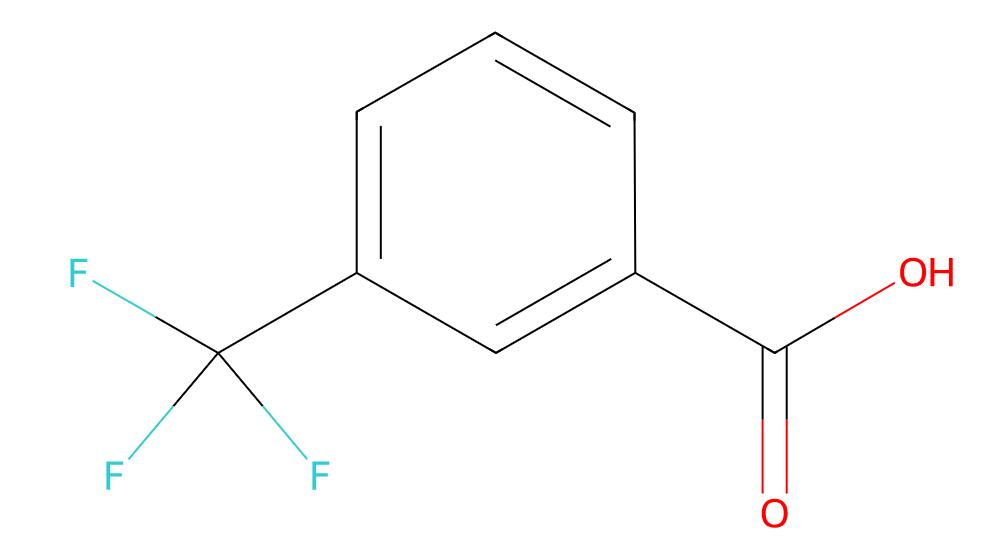 |
| CAS Registry Number | 454-92-2 |
| EINECS Number | 207-230-2 |
| MDL Number | MFCD00002519 |
| Beilstein Registry Number | 2049239 |
| Synonyms | 3-(trifluoromethyl)benzoic acidm-trifluoromethylbenzoic acid3‐(trifluoromethyl)benzoic acid |
| Molecular Formula | CF3C6H4CO2H |
| Molecular Weight | 190.12 |
| InChI | InChI=1S/C8H5F3O2/c9-8(10,11)6-3-1-2-5(4-6)7(12)13/h1-4H,(H,12,13) |
| InChI Key | InChI=1S/C8H5F3O2/c9-8(10,11)6-3-1-2-5(4-6)7(12)13/h1-4H,(H,12,13) |
| Canonical SMILES | O=C(O)c1cccc(C(F)(F)F)c1 |
| Patent Information | ||
| Patent ID | Title | Publication Date |
| CN122036713, | A quinoline-derived compound and its preparation method and application | 2026 |
| WO2026/120023 | AZASPIROHEPTANE DERIVATIVES AS DDR INHIBITORS | 2026 |
Physical Data
| Appearance | White crystalline powder |
| Solubility | No data available |
| Flash Point | 237-240°C |
| Refractive index | No data available |
| Sensitivity | No data available |
| Melting Point, °C |
| 101.4 – 102.6 |
| 102 – 104 |
| 105 |
| 110 |
| Boiling Point, °C | Pressure (Boiling Point), Torr |
| 44 | 1 |
| 125 – 126 | 12 |
| 238.5 | 775 |
| Density, g·cm-3 | Measurement Temperature, °C |
| 1.371 | 25 |
Spectra
| Description (NMR Spectroscopy) | Nucleus (NMR Spectroscopy) | Solvents (NMR Spectroscopy) | Frequency (NMR Spectroscopy), MHz |
| Chemical shifts, Spectrum | 1H | dimethylsulfoxide-d6 | 600 |
| Chemical shifts, Spectrum | 13C | dimethylsulfoxide-d6 | 150 |
| Chemical shifts, Spectrum | 19F | dimethylsulfoxide-d6 | 565 |
| Chemical shifts, Spectrum | 1H | chloroform-d1 | 400 |
| Description (IR Spectroscopy) | Solvent (IR Spectroscopy) |
| Bands | neat (no solvent, solid phase) |
| Spectrum, Bands, Intensity of IR bands | potassium bromide |
| Bands | potassium bromide |
| Bands | potassium bromide |
| IR | vapour |
| Description (Mass Spectrometry) |
| spectrum, time-of-flight mass spectra (TOFMS), high resolution mass spectrometry (HRMS) |
| spectrum, time-of-flight mass spectra (TOFMS), electrospray ionisation (ESI), high resolution mass spectrometry (HRMS) |
| spectrum, electrospray ionisation (ESI), high resolution mass spectrometry (HRMS) |
| spectrum, gas chromatography mass spectrometry (GCMS) |
| Description (UV/VIS Spectroscopy) | Solvent (UV/VIS Spectroscopy) | Comment (UV/VIS Spectroscopy) | Absorption Maxima (UV/VIS), nm | Ext./Abs. Coefficient, l·mol-1cm-1 |
| Spectrum | water | 195, 223 | ||
| Absorption maxima | H2O, H2SO4 | Ratio of solvents: 66percent | 228, 272 | 11481, 603 |
| Absorption maxima | H2O, NaOH | Ratio of solvents: 0.1N | 250, 292 | 14125, 2239 |
| Description (Raman Spectroscopy) |
| Spectrum, Bands |
| Bands, Spectrum |
| Bands |
Route of Synthesis (ROS)
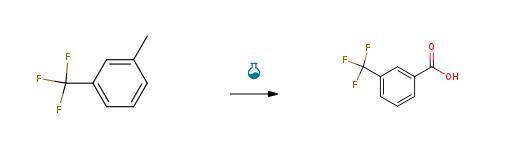
| Conditions | Yield |
| With α,α,α-trifluorotoluene; bromine In water at 20℃; for 24h; Irradiation; | 90% |
| With oxygen In dichloromethane; acetonitrile at 35℃; under 760.051 Torr; for 12h; Irradiation; | 82% |
| With water In acetonitrile for 22h; UV-irradiation; | 75.9% |
| With 1-hydroxy-pyrrolidine-2,5-dione; oxygen; nitric acid at 100℃; under 1500.15 – 7500.75 Torr; for 30h; Autoclave; Green chemistry; |
Safety and Hazards
| Pictogram(s) |  |
| Signal | Warning |
| GHS Hazard Statements | H315 (100%): Causes skin irritation [Warning Skin corrosion/irritation] H319 (100%): Causes serious eye irritation [Warning Serious eye damage/eye irritation] H335 (97.9%): May cause respiratory irritation [Warning Specific target organ toxicity, single exposure; Respiratory tract irritation] Information may vary between notifications depending on impurities, additives, and other factors. |
| Precautionary Statement Codes | P261, P264, P264+P265, P271, P280, P302+P352, P304+P340, P305+P351+P338, P319, P321, P332+P317, P337+P317, P362+P364, P403+P233, P405, and P501 (click each P-code to see the statement) (The corresponding statement to each P-code can be found at the GHS Classification page.) |
Other Data
| Transportation | NONH for all modes of transport |
| Under the room temperature and away from light | |
| HS Code | No data available |
| Storage | Under the room temperature and away from light |
| Shelf Life | 1 year |
| Market Price | USD |
| Druglikeness | |
| Lipinski rules component | |
| Molecular Weight | 190.122 |
| logP | 2.562 |
| HBA | 2 |
| HBD | 1 |
| Matching Lipinski Rules | 4 |
| Veber rules component | |
| Polar Surface Area (PSA) | 37.3 |
| Rotatable Bond (RotB) | 2 |
| Matching Veber Rules | 2 |
| Use Pattern |
| It is a fluorine-containing organic synthesis intermediate used in LCD liquid crystal monomers, OLED-related functional materials, optoelectronic materials, etc. |
Buy Reagent | |
| No reagent supplier? | Send quick inquiry to ChemWhat |
| Want to be listed here as a reagent supplier? (Paid service) | Click here to contact ChemWhat |
Approved Manufacturers | |
| Warshel Chemical Ltd | http://www.warshel.com/ |
| Want to be listed as an approved manufacturer (Requires approvement)? | Please download and fill out this form and send back to approved-manufacturers@chemwhat.com |
Other Suppliers | |
| Watson International Limited | Visit Watson Official Website |
Contact Us for Other Help | |
| Contact us for other information or services | Click here to contact ChemWhat |