4-[(5R)-5-(3,5-dichlorophenyl)-5-(trifluoromethyl)-4H-1,2-oxazol-3-yl]-2-methyl-N-[2-oxo-2-(2,2,2-trifluoroethylamino)ethyl]benzamide CAS#: 864731-61-3; ChemWhat Code: 1254258

Identification
| Product Name | 4-[(5R)-5-(3,5-dichlorophenyl)-5-(trifluoromethyl)-4H-1,2-oxazol-3-yl]-2-methyl-N-[2-oxo-2-(2,2,2-trifluoroethylamino)ethyl]benzamide |
| IUPAC Name | 4-[5-(3,5-dichlorophenyl)-5-(trifluoromethyl)-4H-1,2-oxazol-3-yl]-2-methyl-N-[2-oxo-2-(2,2,2-trifluoroethylamino)ethyl]benzamide |
| Molecular Structure | 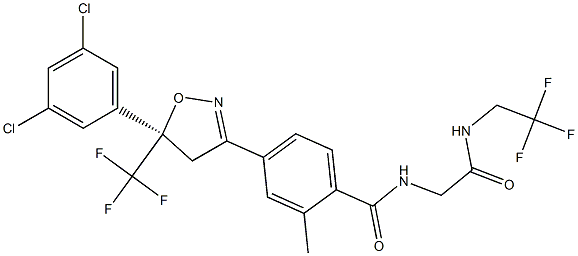 |
| CAS Registry Number | 864731-61-3 |
| MDL Number | MFCD30533410 |
| Synonyms | Fluralaner 864731-61-3 Bravecto (+/-)-Fluralaner Fluralaner, (+/-)- AH252723 UNII-WSH8393RM5 A-1443 WSH8393RM5 FLURALANER (EMA EPAR: VETERINARY) AH-252723 DTXSID90235581 4-[5-(3,5-dichlorophenyl)-5-(trifluoromethyl)-4H-1,2-oxazol-3-yl]-2-methyl-N-[2-oxo-2-(2,2,2-trifluoroethylamino)ethyl]benzamide 4-(5-(3,5-Dichlorophenyl)-5-(trifluoromethyl)-4,5-dihydro-1,2-oxazol-3-yl)-2-methyl-n-(2-oxo-2-((2,2,2-trifluoroethyl)amino)ethyl)benzamide Fluralaner [INN] Fluralaner [USAN:INN] fluralanerum Bravecto 1-Month 4-[5-(3,5-Dichlorophenyl)-4,5-dihydro-5-(trifluoromethyl)-3-isoxazolyl]-2-methyl-N-[2-oxo-2-[(2,2,2-trifluoroethyl)amino]ethyl]benzamide; 4-[5-(3,5-Dichlorophenyl)-5-(trifluoromethyl)-4,5-dihydro-1,2-oxazol-3-yl]-2-methyl-N-[2-oxo-2-[(2,2,2-trifluoroethyl)amino]ethyl]benzamide; A 1443; AH 252723; Bravecto; Fluralaner 4-[5-(3,5-Dichlorophenyl)-5-(trifluoromethyl)-4,5-dihydro-1,2-oxazol-3-yl]-2-methyl-N-{2-oxo-2-[(2,2,2-trifluoroethyl)amino]ethyl}benzamide FLURALANER [MI] Fluralaner (USAN/INN) FLURALANER [USAN] SCHEMBL121934 FLURALANER [GREEN BOOK] CHEMBL2364610 DTXCID20158072 MLBZKOGAMRTSKP-UHFFFAOYSA-N AMY40808 BCP23785 EX-A3266 s6470 AKOS037515661 CS-6526 NCGC00509862-02 AC-37195 Fluralaner 100 microg/mL in Acetonitrile HY-16973 MS-30137 D10402 F85532 Q18326579 AH252723; AH-252723; AH 252723; A-1443; A1443; A 1443 4-(5-(3,5-Dichlorophenyl)-5-(trifluoromethyl)-4,5-dihydroisoxazol-3-yl)-2-methyl-N-(2-oxo-2-(2,2,2-trifluoroethylamino)ethyl)benzamide BENZAMIDE, 4-(5-(3,5-DICHLOROPHENYL)-4,5-DIHYDRO-5-(TRIFLUOROMETHYL)-3-ISOXAZOLYL)-2-METHYL-N-(2-OXO-2-((2,2,2-TRIFLUOROETHYL)AMINO)ETHYL)- (2) 4-(5-(3,5-DICHLOROPHENYL)-5-(TRIFLUOROMETHYL)-4,5-DIHYDRO-1,2-OXAZOL-3-YL)-2-METHYL-N-(2-OXO-2-((2,2,2-TRIFLUOROETHYL)AMINO)ETHYL)BENZAMIDE. |
| Molecular Formula | C22H17Cl2F6N3O3 |
| Molecular Weight | 556.3 |
| InChI | InChI=1S/C22H17Cl2F6N3O3/c1-11-4-12(2-3-16(11)19(35)31-9-18(34)32-10-21(25,26)27)17-8-20(36-33-17,22(28,29)30)13-5-14(23)7-15(24)6-13/h2-7H,8-10H2,1H3,(H,31,35)(H,32,34) |
| InChI Key | MLBZKOGAMRTSKP-UHFFFAOYSA-N |
| Isomeric SMILES | CC1=C(C=CC(=C1)C2=NOC(C2)(C3=CC(=CC(=C3)Cl)Cl)C(F)(F)F)C(=O)NCC(=O)NCC(F)(F)F |
| Patent Information | ||
| Patent ID | Title | Publication Date |
| WO2023/12821 | A PROCESS FOR THE PREPARATION OF CARBAMOYL BENZAMIDE PHENYL ISOXAZOLINE CLASS DRUG/S AND ITS INTERMEDIATES | 2023 |
| CN116396235 | Synthetic method of isoxazoline insecticide and intermediate thereof | 2023 |
| US2022/242835 | ISOXAZOLINE COMPOUNDS AND USE THEREOF | 2022 |
| WO2022/258797 | TICK CONTROL METHODS | 2022 |
| CN112457267 | Preparation method of isoxazoline insecticide | 2021 |
Physical Data
No data available
| Melting Point, °C | Solvent (Melting Point) |
| 165 – 167 | |
| 170.9 | |
| 173.5 – 175.5 | hexane |
Spectra
| Description (NMR Spectroscopy) | Nucleus (NMR Spectroscopy) | Solvents (NMR Spectroscopy) | Frequency (NMR Spectroscopy), MHz |
| Chemical shifts | 1H | chloroform-d1 | |
| Chemical shifts, Spectrum | 1H | dimethylsulfoxide-d6 | |
| Chemical shifts, Spectrum | 13C | dimethylsulfoxide-d6 | |
| Chemical shifts | 1H | dimethylsulfoxide-d6 | 300 |
Route of Synthesis (ROS)
![Route of Synthesis (ROS) of 4-[(5R)-5-(3,5-dichlorophenyl)-5-(trifluoromethyl)-4H-1,2-oxazol-3-yl]-2-methyl-N-[2-oxo-2-(2,2,2-trifluoroethylamino)ethyl]benzamide CAS 864731-61-3](https://www.chemwhat.com/wp-content/uploads/2018/09/Route-of-Synthesis-ROS-of-4-5R-5-35-dichlorophenyl-5-trifluoromethyl-4H-12-oxazol-3-yl-2-methyl-N-2-oxo-2-222-trifluoroethylaminoethylbenzamide-CAS-864731-61-3.png)
Route of Synthesis (ROS) of 4-[(5R)-5-(3,5-dichlorophenyl)-5-(trifluoromethyl)-4H-1,2-oxazol-3-yl]-2-methyl-N-[2-oxo-2-(2,2,2-trifluoroethylamino)ethyl]benzamide CAS 864731-61-3
| Conditions | Yield |
| With triethylamine In N,N-dimethyl-formamide at 20℃; for 14h; Experimental Procedure d) 200 ml of DMF, intermediate 3-1 42.2 g (0.12 mol) and 1,3-dichloro-5-(1-trifluoromethyl-vinyl)benzene were added in a 500 ml round bottom flask under stirring. 33.7 g (0.14 mol). After the mixture solution was dissolved, 13.2 g (0.13 mol) of triethylamine was added, and the reaction was continued at room temperature for 14 hours;e) The reaction was stopped: 200 ml of water was added to the reaction liquid, and ethyl acetate 100 ml × 3 times aqueous phase was sequentially added to the reaction liquid. After combining the ethyl acetate phases, the organic phase is dried over anhydrous sodium sulfate;f) Ethyl acetate was evaporated under reduced pressure at 45 to 50 ° C to give crude compound 1-1. The crude product was recrystallized from ethyl acetate/petroleum ether to give compound 1-1 61.5 g, HPLC purity 99.6%, yield 92.1%. | 92.1% |
| With triethylamine In N,N-dimethyl-formamide at 20℃; for 14h; Experimental Procedure d) 200 ml of DMF, intermediate 3-1 42.2 g (0.12 mol) and 1,3-dichloro-5-(1-trifluoromethyl-vinyl)benzene were added in a 500 ml round bottom flask under stirring. 33.7 g (0.14 mol). After the mixture solution was dissolved, 13.2 g (0.13 mol) of triethylamine was added, and the reaction was continued at room temperature for 14 hours;e) The reaction was stopped: 200 ml of water was added to the reaction liquid, and ethyl acetate 100 ml × 3 times aqueous phase was sequentially added to the reaction liquid. After combining the ethyl acetate phases, the organic phase is dried over anhydrous sodium sulfate;f) Ethyl acetate was evaporated under reduced pressure at 45 to 50 ° C to give crude compound 1-1. The crude product was recrystallized from ethyl acetate/petroleum ether to give compound 1-1 61.5 g, HPLC purity 99.6%, yield 92.1%. | 92.1% |
| With sodium hydrogencarbonate In tetrahydrofuran at 20℃; Experimental Procedure In a 1000mL round bottom flask,Under stirring, 58.9g of Intermediate-II,59.2g 1,3-dichloro-5-(1-trifluoromethyl-vinyl)benzeneand 450 mL of tetrahydrofuran;added at room temperature16.3g sodium bicarbonate, react at room temperature for 6-8h;After the reaction is completed,Concentrate under reduced pressure to remove the solvent,Use 450mL*3 dichloromethaneExtracted with 450 mL of saturated aqueous sodium chloride solution,After the dichloromethane phase was dewatered with anhydrous sodium sulfate,Concentrated to dryness to obtain crude Florana.flairanaThe crude product is pulped with n-heptane,After recrystallization from ethyl acetate/toluene, the product of Florana was obtained.HPLC purity 99.8%,Yield 91.8%. | 91.8% |
| With N-ethyl-N,N-diisopropylamine In N,N-dimethyl-formamide at 20 – 30℃; Reagent/catalyst; Temperature; Solvent; Experimental Procedure In a 250 mL flask,Intermediate 4 (10 g, 28.4 mmol) was added,50 mL DMF,and 1,3-dichloro-5-(1-trifluoromethyl-vinyl)benzene (7.2 g, 30 mmol),Stir to dissolve, control the temperature to 10~20,Diisopropylethylamine (5.5 g, 42.6 mmol) was slowly added dropwise.After dripping, control the temperature to 20~30,Reaction 1~3h;After the reaction was detected by TLC, 100 mL of water was added dropwise.Stir to crystallize, filter, and drainto obtain crude Florana;150 mL of methanol was added to the crude Florana, and the temperature was raised to 40-45 °C.Stir to dissolve, slowly add 75 mL of water to crystallize, and drop the crystals for 1 h.filter, wash, vacuum dry13.4 g of Florana crystals were obtained with a purity of 99.5% and a molar yield of 85%. | 85% |
Safety and Hazards
| Pictogram(s) |   |
| Signal | Warning |
| GHS Hazard Statements | H361 (19.07%): Suspected of damaging fertility or the unborn child [Warning Reproductive toxicity] H400 (80.41%): Very toxic to aquatic life [Warning Hazardous to the aquatic environment, acute hazard] H410 (100%): Very toxic to aquatic life with long lasting effects [Warning Hazardous to the aquatic environment, long-term hazard] |
| Precautionary Statement Codes | P203, P273, P280, P318, P391, P405, and P501 (The corresponding statement to each P-code can be found at the GHS Classification page.) |
Other Data
No data available
| Druglikeness | |
| Lipinski rules component | |
| Molecular Weight | 556.292 |
| logP | 6.965 |
| HBA | 4 |
| HBD | 2 |
| Matching Lipinski Rules | 2 |
| Veber rules component | |
| Polar Surface Area (PSA) | 79.79 |
| Rotatable Bond (RotB) | 10 |
| Matching Veber Rules | 2 |
| Use Pattern |
| 4-[(5R)-5-(3,5-dichlorophenyl)-5-(trifluoromethyl)-4H-1,2-oxazol-3-yl]-2-methyl-N-[2-oxo-2-(2,2,2-trifluoroethylamino)ethyl]benzamide CAS#: 864731-61-3 is a systemic insecticide and acaricide that is administered orally or topically. The U.S. Food and Drug Administration (FDA) approved it under the trade name Bravecto for flea treatment in dogs in May 2014 and Bravecto Plus as a topical treatment for cats in November 2019, with warnings about possible side effects in both species. The EU approved the drug in February 2014. Australia approved it for the treatment and prevention of ticks and fleas on dogs in January 2015. |
Buy Reagent | |
| No reagent supplier? | Send quick inquiry to ChemWhat |
| Want to be listed here as a reagent supplier? (Paid service) | Click here to contact ChemWhat |
Approved Manufacturers | |
| Want to be listed as an approved manufacturer (Requires approvement)? | Please download and fill out this form and send back to approved-manufacturers@chemwhat.com |
Other Suppliers | |
| Watson International Limited | Visit Watson Official Website |
Contact Us for Other Help | |
| Contact us for other information or services | Click here to contact ChemWhat |