| Official Full Name |
Recombinant Human Neurotrophin-4 (rHuNT-4) |
| Squence |
 |
| Amino Acid Sequence |
MGVSETAPAS RRGELAVCDA VSGWVTDRRT AVDLRGREVE VLGEVPAAGG SPLRQYFFET RCKADNAEEG GPGAGGGGCR GVDRRHWVSE CKAKQSYVRA LTADAQGRVG WRWIRIDTAC VCTLLSRTGR A |
| Synonyms |
Neurotrophin-5, NT-5 |
| Accession Number |
P34130 |
| GeneID |
4909 |
| Summary |
NT-4 also named as NT-5 is a neuronal and epithelial grow factor belongs to the NGF-beta family. The NT-4 precursor is consisted of a 24 a.a. signal peptide, a 56 a.a. propertied and 130 a.a. NT-4. The mature protein has six Cys amino acid residues and has the relative structure with NT-3, BDNF (sharing about 48 % – 52 % sequence identity). Additionally, it shares 91 % and 95 % a.a. sequence identity with mouse and rat NT-4. NT-4 is mainly expressed in prostate and has low level thymus, placenta, and skeletal muscle. It can binding with the LNGFR and trkB receptors and plays a crucial role in the regulation of survival and the maintenance of peripheral sensory sympathetic neurons. Defect of NT-4 may cause primary open angle glaucoma type 1O. |
| Source |
Escherichia coli. |
| Molecular Weight |
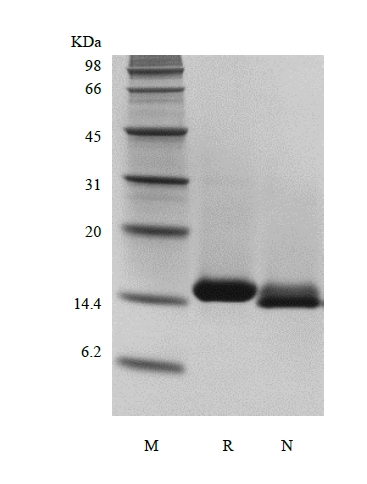
Approximately 28.1 kDa, a noncovalently linked homodimer of two 14.0 kDa polypeptide monomers (262 total amino acid residues). |
| Biological Activity |
Fully biologically active when compared to standard. The ED50 as determined by the dose-dependent induction of choline acetyl transferase activity in rat basal forebrain primary septal cell cultures is less than 50 ng/ml, corresponding to a specific activity of > 2.0 × 10⁴ IU/mg. |
| Appearance |
Sterile filtered white lyophilized (freeze-dried) powder. |
| Formulation |
Lyophilized from a 0.2 um filtered concentrated solution in PBS, pH 5.5. |
| Endotoxin |
Less than 1 EU/ug of rHuNT-4 as determined by LAL method. |
| Reconstitution |
We recommend that this vial be briefly centrifuged prior to opening to bring the contents to the bottom. Reconstitute in sterile distilled water or aqueous buffer containing 0.1 % BSA to a concentration of 0.1-1.0 mg/mL. Stock solutions should be apportioned into working aliquots and stored at ≤ -20 °C. Further dilutions should be made in appropriate buffered solutions. |
| Stability and Storage |
Use a manual defrost freezer and avoid repeated freeze-thaw cycles.- 12 months from date of receipt, -20 to -70 °C as supplied.- 1 month, 2 to 8 °C under sterile conditions after reconstitution.- 3 months, -20 to -70 °C under sterile conditions after reconstitution. |
| References |
|
| SDS-PAGE |
 |
| Safety Data Sheet (SDS) Download |
Click to download |
| Technical Data Sheet (TDS) Download |
Click to download |