Ebexagliflozin CAS#: 1118567-05-7; ChemWhat Code: 1054273

Identification
| Product Name | Ebexagliflozin |
| IUPAC Name | (2S,3R,4R,5S,6R)-2-[4-chloro-3-[[4-(2-cyclopropyloxyethoxy)phenyl]methyl]phenyl]-6-(hydroxymethyl)oxane-3,4,5-triol |
| Molecular Structure | 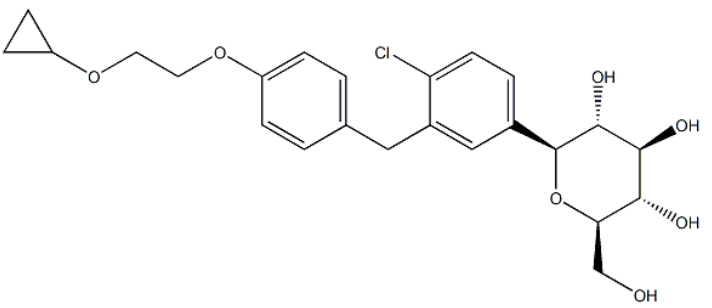 |
| CAS Registry Number | 1118567-05-7 |
| MDL Number | MFCD28100944 |
| Synonyms | 3-Pyridinamin;3-Pyridinamine;3-Pyridinamine;pyridin-3-amine;T6NJ CZ;3- Aminopyridine;3-Amino-pyridine;3-pyridylamine;Amino-3 pyridine;m-Aminopyridine;MS/MS-1064463;Pyridin-3-ylamine;Pyridine, 3-amino-;β-Aminopyridine 462-08-8 |
| Molecular Formula | C24H29ClO7 |
| Molecular Weight | 464.9 |
| InChI | InChI=1S/C24H29ClO7/c25-19-8-3-15(24-23(29)22(28)21(27)20(13-26)32-24)12-16(19)11-14-1-4-17(5-2-14)30-9-10-31-18-6-7-18/h1-5,8,12,18,20-24,26-29H,6-7,9-11,13H2/t20-,21-,22+,23-,24+/m1/s1 |
| InChI Key | BTCRKOKVYTVOLU-SJSRKZJXSA-N |
| Isomeric SMILES | C1CC1OCCOC2=CC=C(C=C2)CC3=C(C=CC(=C3)[C@H]4[C@@H]([C@H]([C@@H]([C@H](O4)CO)O)O)O)Cl |
Physical Data
| Melting Point, °C |
| 132.5 – 133.5 |
| 136.31 |
Spectra
| Description (NMR Spectroscopy) | Nucleus (NMR Spectroscopy) | Solvents (NMR Spectroscopy) | Temperature (NMR Spectroscopy), °C | Frequency (NMR Spectroscopy), MHz |
| Chemical shifts | 1H | CD3OD | 500 | |
| Chemical shifts, Spectrum | 1H | dimethylsulfoxide-d6 | 400 | |
| Chemical shifts, Spectrum | 13C | dimethylsulfoxide-d6 | 100 | |
| 1H | CD3OD | 19.84 | 400 | |
| 1H | CD3OD | 19.84 |
Route of Synthesis (ROS)

| Conditions | Yield |
| With triethylsilane; boron trifluoride diethyl etherate In dichloromethane; acetonitrile at -25 – -20℃; for 4h; Temperature; Concentration; Inert atmosphere; Large scale; Experimental Procedure 5 Example 5 Preparation of ((2S,3R,4R,5S,6R)-2-(4-Chloro-3-(4-(2-Cyclopropoxyethoxy)Benzyl)Phenyl)-6-(Hydroxymethyl)Tetrahydro-2H-Pyran-3,4,5-triol Example 5 Preparation of ((2S,3R,4R,5S,6R)-2-(4-Chloro-3-(4-(2-Cyclopropoxyethoxy)Benzyl)Phenyl)-6-(Hydroxymethyl)Tetrahydro-2H-Pyran-3,4,5-triol [0236] This example describes preparation of (2S,3R,4R,5S,6R)-2-(4-chloro-3-(4-(2-cyclopropoxyethoxy)benzyl)phenyl)-6-(hydroxymethyl)tetrahydro-2H-pyran-3,4,5-triol by reduction of the anomeric OMe and/or OH. (3R,4S,5S,6R)-2-(4-Chloro-3-(4-(2-Cyclopropoxyethoxy)Benzyl)Phenyl)-6-(Hydroxymethyl)-2-Methoxytetrahydro-2H-Pyran-3,4,5-Triol Solution [0237] A 30 L glass reactor equipped with a thermometer was charged with crude (3R,4S,5S,6R)-2-(4-chloro-3-(4-(2-cyclopropoxyethoxy)benzyl)phenyl)-6-(hydroxymethyl)-2-methoxytetrahydro-2H-pyran-3,4,5-triol (2.7 kg), DCM (5.4 kg) and acetonitrile (3.2 kg), and the mixture was magnetically stirred until all the solids dissolved under nitrogen sparging. [0238] Triethylsilane Solution: [0239] BF3.Et2O (2.34 kg) was added to a cold (-21 to -15° C.) solution of triethysilane (2.55 kg) dichloromethane (5.4 kg) and acetonitrile (3.2 kg) under nitrogen. [0240] The (3R,4S,5S,6R)-2-(4-chloro-3-(4-(2-cyclopropoxyethoxy)benzyl)phenyl)-6-(hydroxymethyl)-2-methoxytetrahydro-2H-pyran-3,4,5-triol solution was added to the cold triethylsilane solution at such a rate to maintain the temperature between -20 and -25° C. (3 h). [0241] The reaction mixture was stirred for another 4 h at -22 to -25° C. and then quenched by addition of an aqueous solution of sodium bicarbonate (7.4% w/w, 18.3 kg) while keeping the internal temperature below -10° C. Solid sodium bicarbonate (1.35 kg) was added to adjust the pH to 7.5. The solvents were removed under reduced pressure (temperature below 40° C.). The residue was partitioned between ethyl acetate (18 kg) and water (9.2 kg). The layers were separated and the aqueous layer was extracted with ethyl acetate (2×9 kg). The combined organic layers were washed with brine (2×9 kg) and the solvents were removed under reduced pressure at the temperature below 40° C. until the condensation almost stop Anhydrous ethanol (9 kg) was added and concentrated to give the crude product of the title compound (2.5 kg, 90% yield, 90.8% HPLC purity, HPLC-0001) as foamy solid. | 90% |
| With triethylsilane; boron trifluoride diethyl etherate In dichloromethane; acetonitrile at -25 – -20℃; Inert atmosphere; diastereoselective reaction; | 70% |
Safety and Hazards
Other Data
| Druglikeness | |
| Lipinski rules component | |
| Molecular Weight | 464.943 |
| logP | 2.867 |
| HBA | 6 |
| HBD | 4 |
| Matching Lipinski Rules | 4 |
| Veber rules component | |
| Polar Surface Area (PSA) | 108.61 |
| Rotatable Bond (RotB) | 9 |
| Matching Veber Rules | 2 |
| Use Pattern |
| Ebexagliflozin CAS#: 1118567-05-7 is a GLT2 inhibitor and a new type of hypoglycemic drug. It can inhibit SGLT2 in renal tubular epithelial cells, leading to an increase in the body’s caloric consumption, reducing fluid retention and increasing urinary glucose excretion. |
Buy Reagent | |
| No reagent supplier? | Send quick inquiry to ChemWhat |
| Want to be listed here as a reagent supplier? (Paid service) | Click here to contact ChemWhat |
Approved Manufacturers | |
| Want to be listed as an approved manufacturer (Requires approvement)? | Please download and fill out this form and send back to approved-manufacturers@chemwhat.com |
Other Suppliers | |
| Watson International Limited | Visit Watson Official Website |
Contact Us for Other Help | |
| Contact us for other information or services | Click here to contact ChemWhat |