Ebselen CAS#: 60940-34-3; ChemWhat Code: 926205

Identification
| Product Name | Ebselen CAS#: 60940-34-3 |
| IUPAC Name | 2-phenyl-1,2-benzoselenazol-3-one |
| Molecular Structure | 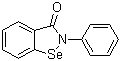 |
| CAS Registry Number | 60940-34-3 |
| EINECS Number | No data available |
| MDL Number | MFCD00210937 |
| Beilstein Registry Number | No data available |
| Synonyms | 2-phenyl-1,2-benzoisoselenazol-3(2H)-oneebselen2-phenyl-1,2-benzisoselenazol-3(2H)-one2-phenylbenzo[d][1,2]selenazol-3(2H)-one2-phenyl-1,2-benzisoselenzol-3(2H)-one |
| Molecular Formula | C13H9NOSe |
| Molecular Weight | 274.181 |
| InChI | InChI=1S/C13H9NOSe/c15-13-11-8-4-5-9-12(11)16-14(13)10-6-2-1-3-7-10/h1-9H |
| InChI Key | DYEFUKCXAQOFHX-UHFFFAOYSA-N |
| Canonical SMILES | O=c1c2ccccc2[se]n1-c1ccccc1 |
| Patent Information | ||
| Patent ID | Title | Publication Date |
| CN119684232 | Ebbuselenium derivative, pharmaceutical composition and application of ebbuselenium derivative | 2025 |
| CN117586204 | Isoselenazolone compound as well as synthesis method and application thereof | 2024 |
| US2023/210818 | COMPOSITION COMPRISING ORGANOSELENIUM COMPOUND FOR TREATMENT OF SKELETAL MUSCLE ATROPHY | 2023 |
Physical Data
| Appearance | Yellow to off-white powder |
| Solubility | No data available |
| Flash Point | No data available |
| Refractive index | No data available |
| Sensitivity | No data available |
| Melting Point, °C | Solvent (Melting Point) |
| 173.4 – 174.6 | |
| 182 – 183 | ethanol |
| 173.2 – 174 |
| Density, g·cm-3 | Measurement Temperature, °C | Type (Density) |
| 1.694 | -173.16 | crystallographic |
| 1.726 | -173.16 | crystallographic |
| 1.727 | -173.16 | crystallographic |
| Description (Association (MCS)) | Solvent (Association (MCS)) | Temperature (Association (MCS)), °C | Partner (Association (MCS)) |
| Association with compound | chloroform-d1 | 24.84 | Nitrite |
| UV/VIS spectrum of the complex | various solvent(s) | bovine serum albumin | |
| UV/VIS spectrum of the complex | various solvent(s) | GLUTATHIONE |
Spectra
| Description (NMR Spectroscopy) | Nucleus (NMR Spectroscopy) | Solvents (NMR Spectroscopy) | Temperature (NMR Spectroscopy), °C | Frequency (NMR Spectroscopy), MHz |
| Chemical shifts, Spectrum | 1H | chloroform-d1 | ||
| Chemical shifts | 1H | dimethylsulfoxide-d6 | 600 | |
| Chemical shifts | 1H | dimethylsulfoxide-d6 | 25 | |
| Chemical shifts | 77Se | chloroform-d1 |
| Description (IR Spectroscopy) | Solvent (IR Spectroscopy) | Temperature (IR Spectroscopy), °C |
| ATR (attenuated total reflectance), Bands, Spectrum | ||
| Bands | potassium bromide | |
| Bands, Spectrum | dichloromethane | 21.84 |
| Bands, Spectrum | dichloromethane | 21.84 |
| Description (Mass Spectrometry) |
| electrospray ionisation (ESI), spectrum |
| high resolution mass spectrometry (HRMS), electrospray ionisation (ESI), time-of-flight mass spectra (TOFMS), spectrum |
| high resolution mass spectrometry (HRMS), spectrum |
| high resolution mass spectrometry (HRMS), electrospray ionisation (ESI), spectrum |
| liquid chromatography mass spectrometry (LCMS), electrospray ionisation (ESI), spectrum |
| Description (UV/VIS Spectroscopy) | Solvent (UV/VIS Spectroscopy) | Comment (UV/VIS Spectroscopy) | Absorption Maxima (UV/VIS), nm |
| Spectrum | aq. phosphate buffer | Ratio of solvents: 66percent | 258 |
| phosphate buffer | 322 | ||
| Spectrum | dimethylsulfoxide | Remark: at 37 deg C, in the presence of inorganic compounds. Object(s) of Study: in the presence of organic compounds | 232, 290 |
| Spectrum | methanol, aq. HCl | 230 – 400 nm |
Route of Synthesis (ROS)
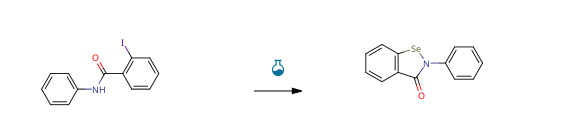
| Conditions | Yield |
| With copper(l) iodide; 1,10-Phenanthroline; potassium selenocyanate; caesium carbonate In acetonitrile at 0 – 20℃; for 16h; Temperature; Wavelength; Solvent; Irradiation; Inert atmosphere; Sealed tube; | 92% |
| Stage #1: benodanil With dilithium diselenide In N,N-dimethyl-formamide at 110℃; Inert atmosphere; Stage #2: With water Reagent/catalyst; | 91% |
| With selenium; hydrazine hydrate; lithium hydroxide In N,N-dimethyl-formamide for 20h; Inert atmosphere; Heating; | 91% |
Safety and Hazards
| Pictogram(s) |    |
| Signal | Danger |
| GHS Hazard Statements | H301 (95.6%): Toxic if swallowed [Danger Acute toxicity, oral] H331 (95.6%): Toxic if inhaled [Danger Acute toxicity, inhalation] H373 (97.8%): May causes damage to organs through prolonged or repeated exposure [Warning Specific target organ toxicity, repeated exposure] H400 (97.8%): Very toxic to aquatic life [Warning Hazardous to the aquatic environment, acute hazard] H410 (97.8%): Very toxic to aquatic life with long lasting effects [Warning Hazardous to the aquatic environment, long-term hazard] Information may vary between notifications depending on impurities, additives, and other factors. |
| Precautionary Statement Codes | P260, P261, P264, P270, P271, P273, P301+P316, P304+P340, P316, P319, P321, P330, P391, P403+P233, P405, and P501 (The corresponding statement to each P-code can be found at the GHS Classification page.) |
Other Data
| Transportation | NONH for all modes of transport |
| Under the room temperature and away from light | |
| HS Code | No data available |
| Storage | Under the room temperature and away from light |
| Shelf Life | 2 years |
| Market Price | USD |
| Druglikeness | |
| Lipinski rules component | |
| Molecular Weight | 274.181 |
| logP | 3.126 |
| HBA | 2 |
| HBD | 0 |
| Matching Lipinski Rules | 4 |
| Veber rules component | |
| Polar Surface Area (PSA) | 20.31 |
| Rotatable Bond (RotB) | 1 |
| Matching Veber Rules | 2 |
| Use Pattern |
| Pharmaceuticals |
| combination with polymyxin in the preparation of drugs against Salmonella infection |
| preparation of RecG helicase inhibitors in the preparation of antibacterial agents for inhibiting pathogenic bacteria |
| for treating and/or prophylaxis of a disease or condition associated with cellular stress granule formation |
| prevents or decreases TDP-43 aggregation or oligomerization |
Buy Reagent | |
| No reagent supplier? | Send quick inquiry to ChemWhat |
| Want to be listed here as a reagent supplier? (Paid service) | Click here to contact ChemWhat |
Approved Manufacturers | |
| Caming Pharmaceutical Ltd | http://www.caming.com/ |
| Want to be listed as an approved manufacturer (Requires approvement)? | Please download and fill out this form and send back to approved-manufacturers@chemwhat.com |
Other Suppliers | |
| Watson International Limited | Visit Watson Official Website |
Contact Us for Other Help | |
| Contact us for other information or services | Click here to contact ChemWhat |