Methyl 3-(trifluoromethyl)benzoate CAS#: 2557-13-3; ChemWhat Code: 55182

Identification
| Product Name | Methyl3-(trifluoromethyl)benzoate |
| IUPAC Name | methyl 3-(trifluoromethyl)benzoate |
| Molecular Structure | 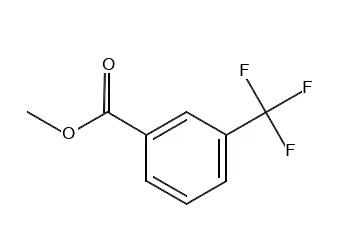 |
| CAS Registry Number | 2557-13-3 |
| EINECS Number | 607-745-6 |
| MDL Number | MFCD00043543 |
| Beilstein Registry Number | 105692 |
| Synonyms | 3-trifluoromethylbenzoic acid methyl estermethyl 3-(trifluoromethyl)benzoatemethyl m-trifluoromethyl benzoatem-trifluoromethylbenzoic acid methyl ester |
| Molecular Formula | C9H7O2F3 |
| Molecular Weight | 204.15 |
| InChI | InChI=1S/C9H7F3O2/c1-14-8(13)6-3-2-4-7(5-6)9(10,11)12/h2-5H,1H3 |
| InChI Key | CUYKNJBYIJFRCU-UHFFFAOYSA-N |
| Canonical SMILES | COC(=O)c1cccc(C(F)(F)F)c1 |
| Patent Information | ||
| Patent ID | Title | Publication Date |
| CN118894780 | Application of carbon-nitrogen-material-loaded selenium nanoparticles in catalysis of 1-phenethyl alcohol or derivatives thereof to preparation of methyl benzoate or derivatives thereof | 2024 |
| CN113354513 | Alpha, alpha-dideuterated benzyl alcohol compound, deuterated medicine and reduction deuteration method of benzoate compound | 2021 |
Physical Data
| Appearance | Colorless and transparent liquid |
| Solubility | No data available |
| Flash Point | 105 °F |
| Refractive index | n20/D 1.453(lit.) |
| Sensitivity | No data available |
| Boiling Point, °C | Pressure (Boiling Point), Torr |
| 76 | 17 |
| 75 – 77 | 18 |
| 82 – 84 | 0.5 |
| 92 | 25 |
| 198 | 760 |
| 93.5 – 94.5 | 20 |
| Refractive Index | Wavelength (Refractive Index), nm | Temperature (Refractive Index), °C |
| 1.4524 | 589 | 20 |
Spectra
| Description (NMR Spectroscopy) | Nucleus (NMR Spectroscopy) | Solvents (NMR Spectroscopy) | Temperature (NMR Spectroscopy), °C | Frequency (NMR Spectroscopy), MHz |
| Chemical shifts, Spectrum | 1H | chloroform-d1 | 24.84 | 400 |
| Chemical shifts, Spectrum | 13C | chloroform-d1 | 24.84 | 101 |
| Chemical shifts, Spectrum | 19F | chloroform-d1 | 24.84 | 376 |
| Chemical shifts, Spectrum | 19F | chloroform-d1 | 376 |
| Description (IR Spectroscopy) | Solvent (IR Spectroscopy) | Comment (IR Spectroscopy) |
| Bands, ATR (attenuated total reflectance) | ||
| Bands | neat (no solvent) | 1720 cm**(-1) |
| Bands | CHCl3 | 1730 cm**(-1) |
| Bands | dimethylsulfoxide | 1726 cm**(-1) |
| Intensity of IR bands | ||
| IR |
| Description (Mass Spectrometry) |
| spectrum, electron impact (EI), gas chromatography mass spectrometry (GCMS) |
| spectrum |
| spectrum, electron impact (EI), high resolution mass spectrometry (HRMS) |
| spectrum, time-of-flight mass spectra (TOFMS), electrospray ionisation (ESI), high resolution mass spectrometry (HRMS) |
| spectrum, tandem mass spectrometry, high resolution mass spectrometry (HRMS), electrospray ionisation (ESI) |
| Spectrum, EI (Electron impact) |
Route of Synthesis (ROS)
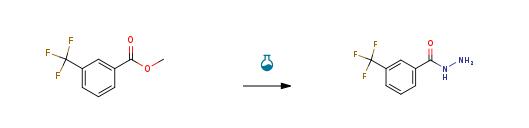
| Conditions | Yield |
| With hydrazine hydrate In methanol at 0 – 20℃; for 16h; | 100% |
| With hydrazine hydrate In methanol for 5h; Reflux; | 99% |
| With hydrazine hydrate In methanol Reflux; | 83% |
Safety and Hazards
| Pictogram(s) |   |
| Signal | Warning |
| GHS Hazard Statements | H226 (87.2%): Flammable liquid and vapor [Warning Flammable liquids] H315 (97.9%): Causes skin irritation [Warning Skin corrosion/irritation] H319 (97.9%): Causes serious eye irritation [Warning Serious eye damage/eye irritation] H335 (95.7%): May cause respiratory irritation [Warning Specific target organ toxicity, single exposure; Respiratory tract irritation] Information may vary between notifications depending on impurities, additives, and other factors. |
| Precautionary Statement Codes | P210, P233, P240, P241, P242, P243, P261, P264, P264+P265, P271, P280, P302+P352, P303+P361+P353, P304+P340, P305+P351+P338, P319, P321, P332+P317, P337+P317, P362+P364, P370+P378, P403+P233, P403+P235, P405, and P501 (click each P-code to see the statement) (The corresponding statement to each P-code can be found at the GHS Classification page.) |
Other Data
| Transportation | NONH for all modes of transport |
| Under the room temperature and away from light | |
| HS Code | No data available |
| Storage | Under the room temperature and away from light |
| Shelf Life | 2 years |
| Market Price | USD |
| Druglikeness | |
| Lipinski rules component | |
| Molecular Weight | 204.149 |
| logP | 2.883 |
| HBA | 2 |
| HBD | 0 |
| Matching Lipinski Rules | 4 |
| Veber rules component | |
| Polar Surface Area (PSA) | 26.3 |
| Rotatable Bond (RotB) | 3 |
| Matching Veber Rules | 2 |
| Use Pattern |
| It is an important fluorine-containing organic intermediate used in the synthesis of: liquid crystal display (LCD) monomers, OLED functional materials, optoelectronic materials, and specialty electronic chemicals. |
Buy Reagent | |
| No reagent supplier? | Send quick inquiry to ChemWhat |
| Want to be listed here as a reagent supplier? (Paid service) | Click here to contact ChemWhat |
Approved Manufacturers | |
| Want to be listed as an approved manufacturer (Requires approvement)? | Please download and fill out this form and send back to approved-manufacturers@chemwhat.com |
Other Suppliers | |
| Watson International Limited | Visit Watson Official Website |
Contact Us for Other Help | |
| Contact us for other information or services | Click here to contact ChemWhat |