Naphthalimidyltrifluromethan sulfornate CAS#: 171417-91-7; ChemWhat Code: 1499753

Identification
| Product Name | Naphthalimidyltrifluromethan sulfornate |
| IUPAC Name | (1,3-dioxobenzo[de]isoquinolin-2-yl) 1,1,2,2,3,3,4,4,4-nonafluorobutane-1-sulfonate |
| Molecular Structure | 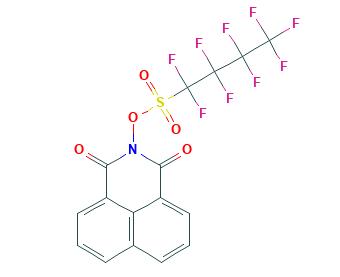 |
| CAS Registry Number | 171417-91-7 |
| EINECS Number | No data available |
| MDL Number | No data available |
| Beilstein Registry Number | No data available |
| Synonyms | 1H-Benz[de]isoquinoline-1,3(2H)-dione,2-[[(nonafluorobutyl)sulfonyl]oxy]- N-Nonafluorobutanesulfonyloxy-1,8-naphthalimide Naphthalimidyltrifluromethan Sulfornate |
| Molecular Formula | C16H6F9NO5S |
| Molecular Weight | 495.268 |
| InChI | InChI=1S/C16H6F9NO5S/c17-13(18,15(21,22)23)14(19,20)16(24,25)32(29,30)31-26-11(27)8-5-1-3-7-4-2-6-9(10(7)8)12(26)28/h1-6H |
| InChI Key | LDQBXAADVARGKQ-UHFFFAOYSA-N |
| Canonical SMILES | O=C1c2cccc3cccc(c23)C(=O)N1OS(=O)(=O)C(F)(F)C(F)(F)C(F)(F)C(F)(F)F |
| Patent Information |
| No data available |
Physical Data
| Appearance | White to off-white powder |
| Solubility | No data available |
| Flash Point | No data available |
| Refractive index | No data available |
| Sensitivity | No data available |
Spectra
| Description (NMR Spectroscopy) | Nucleus (NMR Spectroscopy) | Solvents (NMR Spectroscopy) | Temperature (NMR Spectroscopy), °C |
| Chemical shifts | 1H | chloroform-d1 | 400 |
| Chemical shifts | 19F | chloroform-d1 |
| Description (IR Spectroscopy) |
| Bands |
| Description (Mass Spectrometry) |
| spectrum, liquid chromatography mass spectrometry (LCMS) |
Route of Synthesis (ROS)

| Conditions | Yield |
| With dmap In tetrahydrofuran at 20℃; for 0.5h; | 1.73g |
Safety and Hazards
| GHS Hazard Statements | Not Classified |
Other Data
| Transportation | NONH for all modes of transport |
| Under the room temperature and away from light | |
| HS Code | |
| Storage | Under the room temperature and away from light |
| Shelf Life | 2 years |
| Market Price | USD |
| Druglikeness | |
| Lipinski rules component | |
| Molecular Weight | 495.279 |
| logP | 5.044 |
| HBA | 4 |
| HBD | 0 |
| Matching Lipinski Rules | 3 |
| Veber rules component | |
| Polar Surface Area (PSA) | 68.28 |
| Rotatable Bond (RotB) | 6 |
| Matching Veber Rules | 2 |
| Use Pattern |
| Photoacid Generator (PAG) in Semiconductor Lithography |
| The primary use of CAS 85342-62-7 is as a non-ionic photoacid generator (PAG) used in chemically amplified photoresists. Upon exposure to UV, DUV, or electron-beam radiation, it generates a strong acid that drives resist chemical reactions needed for pattern formation. |
| Advanced Photoresist Systems |
| Microelectronics & Nanofabrication |
| UV / Radiation-Induced Polymer Chemistry |
| Also used as a cationic photoinitiator, enabling: Cationic polymerization reactions UV-curable coatings and resins (in research/advanced formulations) Polymer surface modification systems |
Buy Reagent | |
| No reagent supplier? | Send quick inquiry to ChemWhat |
| Want to be listed here as a reagent supplier? (Paid service) | Click here to contact ChemWhat |
Approved Manufacturers | |
| WatsonChem Advanced Chemical Materials | https://www.watsonchem.com/ |
| Want to be listed as an approved manufacturer (Requires approvement)? | Please download and fill out this form and send back to approved-manufacturers@chemwhat.com |
Other Suppliers | |
| Watson International Limited | Visit Watson Official Website |
Contact Us for Other Help | |
| Contact us for other information or services | Click here to contact ChemWhat |