Stannous chloride dihydrate CAS#: 10025-69-1; ChemWhat Code: 20411

Identification
| Product Name | Stannous chloride dihydrate |
| IUPAC Name | dichlorotin;hydrate |
| Molecular Structure | 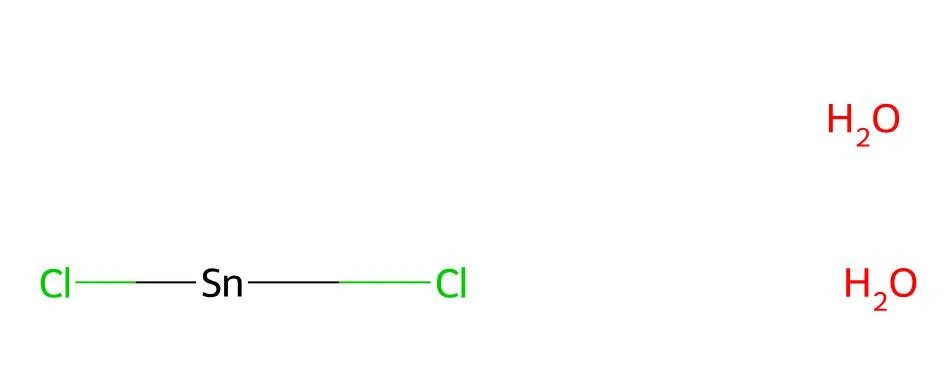 |
| CAS Registry Number | 10025-69-1 |
| EINECS Number | 206-108-6 |
| MDL Number | MFCD00002676 |
| Beilstein Registry Number | No data available |
| Synonyms | tin(II) chloride dihdyratetin(II) chloride dihydratestannous chloride dihydratetin chloride dihydrateSnCl2.2H2Otin dichloride dihydratestannous(II) chloride dihydratetin(II) dichloride dihydratetin(ll) chloride dihydratetin(II) chlorideSnCl2SnCl2·2H2Ostannous dichloride dihydratestannous chloride dehydratedichlorotin dihydratestannous chloridetin(II) chloride dihydrochloridedihydrate stannous chloridestannic chloride dihydratetin(II) chloride dehydrateSnCl2*H2Odichloro-λ2-stannane dihydratetin(ΙΙ) chloride dihydratetin chloride (II) dihydratedihydrate tin(II) chloridetin(II) chloride dyhydratetin chloride hydrateSnCl2 dihydrateH2O |
| Molecular Formula | SnCl2 · 2H2O |
| Molecular Weight | 225.65 |
| InChI | InChI=1S/2ClH.2H2O.Sn/h21H;21H2;/q;;;;+2/p-2 |
| InChI Key | FWPIDFUJEMBDLS-UHFFFAOYSA-L |
| Canonical SMILES | Cl[Sn]Cl.O.O |
| Patent Information | ||
| Patent ID | Title | Publication Date |
| WO2024/129931 | ALPHA-V BETA-6(ανβ6) INTEGRIN LIGANDS FOR EXTRAHEPATIC DELIVERY | 2024 |
| US2012/309797 | PYRIDYL CYANOGUANIDINE DERIVATIVES | 2011 |
Physical Data
| Appearance | White crystals |
| Solubility | No data available |
| Flash Point | No data available |
| Refractive index | No data available |
| Sensitivity | No data available |
| Melting Point, °C |
| 38 |
| 40 |
| 39.5 |
| 32.2 |
| Refractive Index | Wavelength (Refractive Index), nm |
| 1.71 | 632.8 |
| 1.82 | 632.8 |
| 1.83 | 632.8 |
| Density, g·cm-3 | Measurement Temperature, °C |
| 2.707 | |
| 2.71 | 25 |
| 2.634 | 24 |
| Description (Association (MCS)) | Partner (Association (MCS)) |
| Association with compound | methanol |
Spectra
| Description (NMR Spectroscopy) | Nucleus (NMR Spectroscopy) | Solvents (NMR Spectroscopy) | Temperature (NMR Spectroscopy), °C | Frequency (NMR Spectroscopy), MHz |
| Chemical shifts, Spectrum | 119Sn | [D3]acetonitrile | 80 | |
| Chemical shifts, Spectrum | 119Sn | [D3]acetonitrile | ||
| Spectrum | 119Sn | tetrahydrofuran-d8 | 149 | |
| 119Sn | tetrahydrofuran | 25 | ||
| 119Sn | aq. H2SO4 | |||
| 119Sn | dimethylsulfoxide=DMSO | |||
| 119Sn | N,N-dimethylformamide=DMF |
| Description (IR Spectroscopy) | Solvent (IR Spectroscopy) | Temperature (IR Spectroscopy), °C | Comment (IR Spectroscopy) |
| Spectrum, Bands | potassium bromide | ||
| Bands | |||
| Spectrum, Bands | |||
| Bands, ATR (attenuated total reflectance) | 20 | ||
| Spectrum | |||
| Spectrum, Bands | potassium bromide | ||
| Bands | solid | -196.15 | 2980 cm**-1 – 3495 cm**-1 |
| Description (UV/VIS Spectroscopy) | Solvent (UV/VIS Spectroscopy) | Comment (UV/VIS Spectroscopy) | Absorption Maxima (UV/VIS), nm | Ext./Abs. Coefficient, l·mol-1cm-1 |
| Spectrum | methanol | 335 nm – 400 nm | 258 | 5740 |
| Spectrum | further solvent(s) | 335 nm – 400 nm | 232, 290 | 8600, 3120 |
Route of Synthesis (ROS)
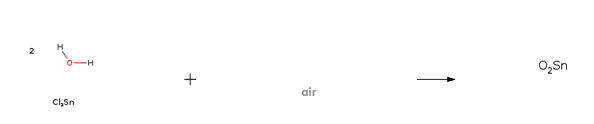
| Conditions | Yield |
| Stage #1: tin(II) chloride dihdyrate With polyvinylpyrrolidone In N,N-dimethyl-formamide at 20℃; for 10h; Stage #2: Electrolysis; Stage #3: air at 550℃; for 3h; Calcination; | |
| Stage #1: tin(II) chloride dihdyrate With hydrogenchloride; water; glycine In 1,2-dimethoxyethane at 20℃; for 0.5h; pH=Ca. 2.2; Sonication; Stage #2: In 1,2-dimethoxyethane; water at 70℃; for 4h; Stage #3: air at 650℃; for 2h; | |
| With 4,7,10-trioxa-1,13-diaminotridecane In propan-1-ol at 80℃; for 5h; | |
| Stage #1: tin(II) chloride dihdyrate With urea In ethanol; water Stage #2: at 180℃; Autoclave; Stage #3: air at 500℃; | |
| Stage #1: tin(II) chloride dihdyrate In methanol at 20℃; for 0.333333h; Stage #2: air at 500℃; for 2h; |
Safety and Hazards
| Pictogram(s) |     |
| Signal | Danger |
| GHS Hazard Statements | H302 (61.9%): Harmful if swallowed [Warning Acute toxicity, oral] H314 (72.4%): Causes severe skin burns and eye damage [Danger Skin corrosion/irritation] H315 (22.1%): Causes skin irritation [Warning Skin corrosion/irritation] H317 (61.7%): May cause an allergic skin reaction [Warning Sensitization, Skin] H318 (49.6%): Causes serious eye damage [Danger Serious eye damage/eye irritation] H332 (23.2%): Harmful if inhaled [Warning Acute toxicity, inhalation] H335 (22.3%): May cause respiratory irritation [Warning Specific target organ toxicity, single exposure; Respiratory tract irritation] H341 (15.3%): Suspected of causing genetic defects [Warning Germ cell mutagenicity] H361 (30.5%): Suspected of damaging fertility or the unborn child [Warning Reproductive toxicity] H373 (38.5%): May causes damage to organs through prolonged or repeated exposure [Warning Specific target organ toxicity, repeated exposure] H400 (43.8%): Very toxic to aquatic life [Warning Hazardous to the aquatic environment, acute hazard] H410 (15.3%): Very toxic to aquatic life with long lasting effects [Warning Hazardous to the aquatic environment, long-term hazard] Information may vary between notifications depending on impurities, additives, and other factors. |
| Precautionary Statement Codes | P203, P260, P261, P264, P264+P265, P270, P271, P272, P273, P280, P301+P317, P301+P330+P331, P302+P352, P302+P361+P354, P304+P340, P305+P354+P338, P316, P317, P318, P319, P321, P330, P332+P317, P333+P317, P362+P364, P363, P391, P403+P233, P405, and P501 (click each P-code to see the statement) (The corresponding statement to each P-code can be found at the GHS Classification page.) |
Other Data
| Transportation | NONH for all modes of transport |
| Under the room temperature and away from light | |
| HS Code | No data available |
| Storage | Under the room temperature and away from light |
| Shelf Life | 1 year |
| Market Price | USD |
| Druglikeness | |
| Lipinski rules component | |
| Molecular Weight | 225.647 |
| logP | 0.557 |
| HBA | 1 |
| HBD | 1 |
| Matching Lipinski Rules | 4 |
| Veber rules component | |
| Polar Surface Area (PSA) | 0 |
| Rotatable Bond (RotB) | 0 |
| Matching Veber Rules | 2 |
| Use Pattern |
| General chemicals |
| reagent in method of preparing a 6-iodo-2-oxindole |
| Electroplating for BGA substrates and IC packaging substrates |
| Optoelectronic and optical coatings, including laser and infrared optical reflectors |
| HJT and perovskite photovoltaic applications |
| Reducing agent for nuclear medicine and analytical applications |
Buy Reagent | |
| No reagent supplier? | Send quick inquiry to ChemWhat |
| Want to be listed here as a reagent supplier? (Paid service) | Click here to contact ChemWhat |
Approved Manufacturers | |
| WatsonChem Advanced Chemical Materials | https://www.watsonchem.com/ |
| Want to be listed as an approved manufacturer (Requires approvement)? | Please download and fill out this form and send back to approved-manufacturers@chemwhat.com |
Other Suppliers | |
| Watson International Limited | Visit Watson Official Website |
Contact Us for Other Help | |
| Contact us for other information or services | Click here to contact ChemWhat |