Stannous sulfate CAS#: 7488-55-3; ChemWhat Code: 18786

Identification
| Product Name | Stannous sulfate |
| IUPAC Name | oxalate;tin(2+) |
| Molecular Structure | 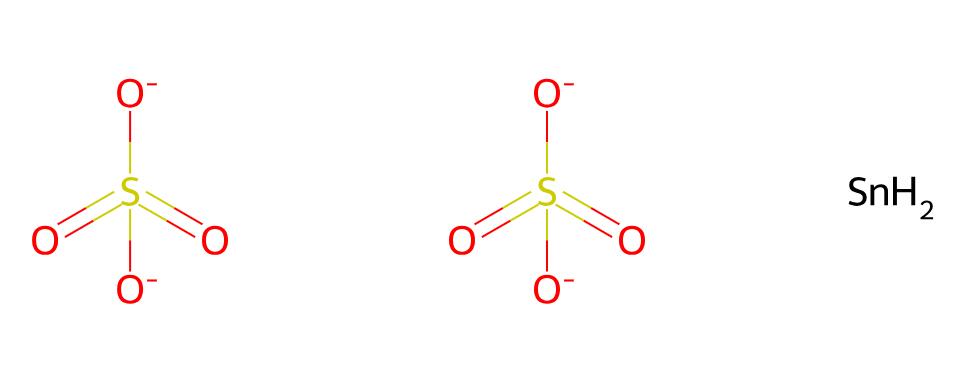 |
| CAS Registry Number | 7488-55-3 |
| EINECS Number | 231-302-2 |
| MDL Number | MFCD00011246 |
| Beilstein Registry Number | No data available |
| Synonyms | $l^{2}-stannane disulfate tin bis(sulphate)tin sulphate |
| Molecular Formula | SnSO4 |
| Molecular Weight | 214.77 |
| InChI | InChI=1S/2H2O4S.Sn.2H/c21-5(2,3)4;;;/h2(H2,1,2,3,4);;;/p-4 |
| InChI Key | IOPRYLMBVSOJAT-UHFFFAOYSA-J |
| Canonical SMILES | O=S(=O)([O-])[O-].O=S(=O)([O-])[O-].[SnH2] |
| Patent Information | |
| No data available |
Physical Data
| Appearance | White powder |
| Solubility | No data available |
| Flash Point | No data available |
| Refractive index | No data available |
| Sensitivity | No data available |
Spectra
| No data available |
Route of Synthesis (ROS)
| No data available |
Safety and Hazards
| Pictogram(s) |    |
| Signal | Danger |
| GHS Hazard Statements | H302+H312+H332 (30.9%): Harmful if swallowed, in contact with skin or if inhaled [Warning Acute toxicity, oral; acute toxicity, dermal; acute toxicity, inhalation] H302 (47.5%): Harmful if swallowed [Warning Acute toxicity, oral] H312 (47.5%): Harmful in contact with skin [Warning Acute toxicity, dermal] H314 (32.6%): Causes severe skin burns and eye damage [Danger Skin corrosion/irritation] H317 (32.6%): May cause an allergic skin reaction [Warning Sensitization, Skin] H318 (76.2%): Causes serious eye damage [Danger Serious eye damage/eye irritation] H332 (32.6%): Harmful if inhaled [Warning Acute toxicity, inhalation] H334 (32.6%): May cause allergy or asthma symptoms or breathing difficulties if inhaled [Danger Sensitization, respiratory] H372 (32.6%): Causes damage to organs through prolonged or repeated exposure [Danger Specific target organ toxicity, repeated exposure] Information may vary between notifications depending on impurities, additives, and other factors. |
| Precautionary Statement Codes | P233, P260, P261, P264, P264+P265, P270, P271, P272, P280, P284, P301+P317, P301+P330+P331, P302+P352, P302+P361+P354, P304+P340, P305+P354+P338, P316, P317, P319, P321, P330, P333+P317, P342+P316, P362+P364, P363, P403, P405, and P501 (click each P-code to see the statement) (The corresponding statement to each P-code can be found at the GHS Classification page.) |
Other Data
| Transportation | NONH for all modes of transport |
| Under the room temperature and away from light | |
| HS Code | No data available |
| Storage | Under the room temperature and away from light |
| Shelf Life | 1 year |
| Market Price | USD |
| Use Pattern |
| Electroplating for advanced semiconductor packaging |
| Electroplating for high-end PCBs and 5G high-frequency connectors |
| Photovoltaic sector (TOPCon ribbon, CZTS thin-film solar cells) |
| Precursors for new energy lithium-ion battery and supercapacitor materials |
Buy Reagent | |
| No reagent supplier? | Send quick inquiry to ChemWhat |
| Want to be listed here as a reagent supplier? (Paid service) | Click here to contact ChemWhat |
Approved Manufacturers | |
| WatsonChem Advanced Chemical Materials | https://www.watsonchem.com/ |
| Want to be listed as an approved manufacturer (Requires approvement)? | Please download and fill out this form and send back to approved-manufacturers@chemwhat.com |
Other Suppliers | |
| Watson International Limited | Visit Watson Official Website |
Contact Us for Other Help | |
| Contact us for other information or services | Click here to contact ChemWhat |